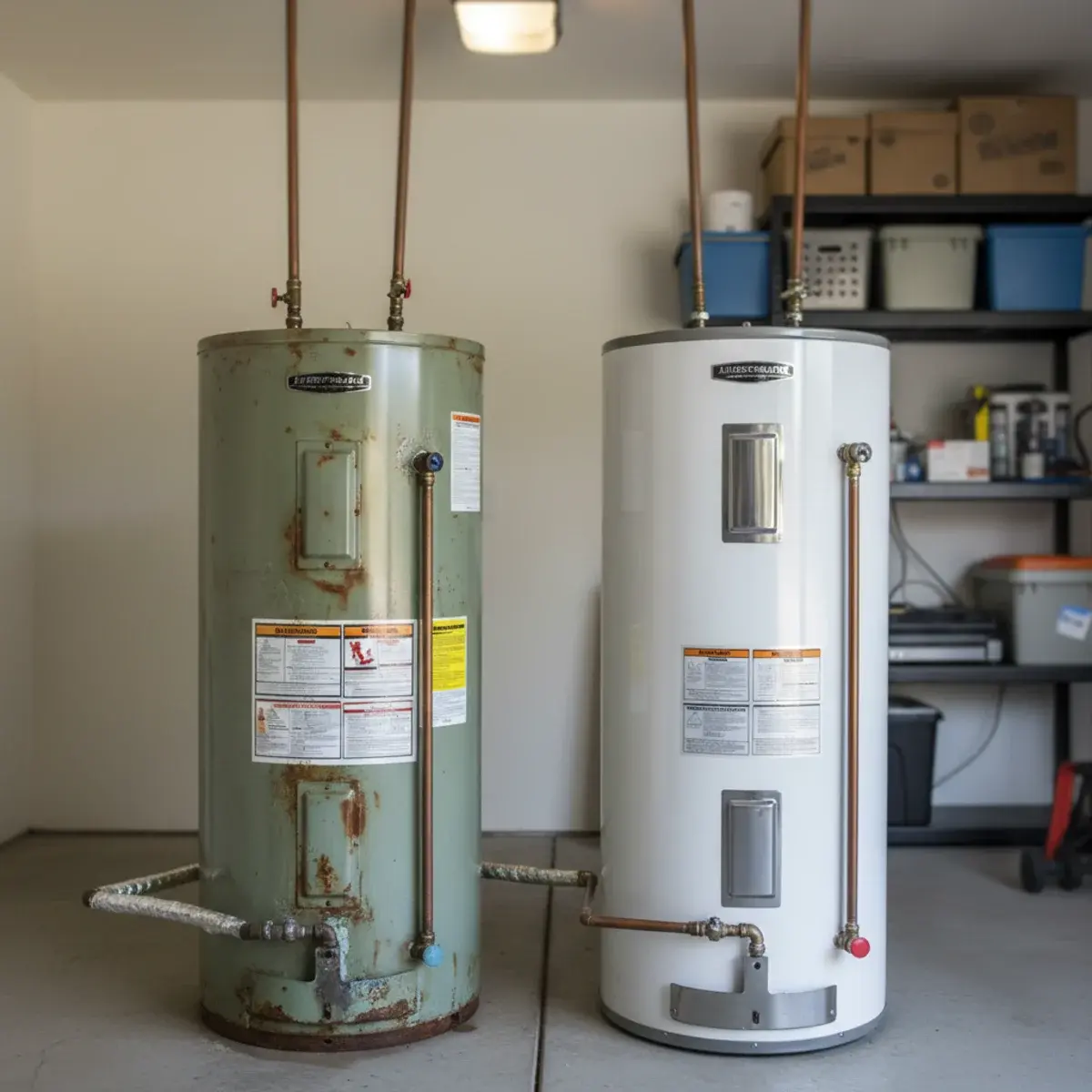
The repair-or-replace decision usually comes down to age, the cost of the fix relative to a new unit, and whether the tank itself is failing. A heater past its expected life with a major problem is usually telling you it is time.
The decision to repair or replace a water heater comes down to three questions: How old is it? How does the repair cost compare to a new unit? And is the tank itself failing, or just a component? A relatively young heater with a failed part is usually worth repairing. An older unit near the end of its life with a significant problem — especially a leaking tank — is usually telling you it is time to replace. Here is how to weigh it.
Start with the age
Age is the single most important factor. A conventional tank water heater typically lasts about 8 to 12 years. A tankless unit can last considerably longer when maintained. Critically, the Inland Empire's hard water shortens these ranges: dissolved minerals settle as sediment in the tank and accelerate corrosion, so a heater here may age faster than the same unit would in a soft-water area.
If you do not know your heater's age, check the serial number on the manufacturer's label — most encode the manufacture date, and a plumber can decode it. As a general rule:
- Under 6–7 years: Lean toward repair for most problems.
- 8–12 years: It depends on the problem and the repair cost. This is the judgment zone.
- Past 12 years: Lean toward replacement, particularly for any significant repair.
Apply the repair-cost rule of thumb
A widely used guideline: if the cost to repair approaches a large fraction of the cost of a new unit — and the heater is already well into its lifespan — replacement is the better value. Spending heavily to repair an old heater often just delays an inevitable replacement, and you lose that repair money when the unit fails for good a year or two later.
By contrast, a modest repair on a heater with years of life left is usually sensible. Replacing a thermocouple, a heating element, a thermostat, or a pressure-relief valve on an otherwise sound unit is routine and cost-effective.
Diagnose the actual problem
Some problems are repairs; others are replacements.
Usually repairable:
- No hot water on a gas unit can be a pilot or thermocouple issue — often a straightforward fix.
- No hot water on an electric unit is frequently a failed heating element or thermostat.
- Inadequate or slow-recovering hot water can sometimes be addressed by flushing sediment, replacing an element, or adjusting settings.
- A leaking valve or fitting can be replaced without replacing the heater.
- Rumbling or popping noises are caused by sediment and can sometimes be improved by flushing the tank, though heavy long-term buildup is a sign of an aging unit.
Usually a replacement:
- The tank itself is leaking. When water seeps from the body of the tank rather than a fitting, internal corrosion has breached it. There is no repair for this — the heater needs to be replaced, and promptly, because the leak will worsen.
- Rusty or discolored hot water that persists after flushing can indicate the tank is corroding from the inside.
- Repeated failures of a heater already at or past its expected age signal the end of its useful life.
Factor in efficiency and your needs
Replacement is not only about failure — it is also an opportunity. A heater more than a decade old is likely far less efficient than current models, so a new unit can lower operating costs. Replacement is also the moment to reconsider whether your current setup fits your household. If you frequently run out of hot water, a larger tank or a tankless system might serve you better; our guide to tankless water heaters walks through that trade-off. Conversely, if your current size has always been fine, a like-for-like replacement keeps things simple.
The hard-water factor in San Bernardino
Because hard water is such a strong influence locally, it deserves its own note. Sediment accumulation is the enemy of tank water heaters here — it insulates the heating element or burner from the water, forces the unit to work harder, causes the rumbling you may hear, and shortens lifespan. Annual flushing slows this down and is worthwhile maintenance. If your heater has never been flushed and is showing its age, that history is part of the replacement calculus. Pairing a new heater with water treatment can also extend its life; our overview of hard-water plumbing problems covers the options.
How to decide, step by step
- Find the age. Decode the serial number or have a plumber do it.
- Identify the problem. Is it a component (often repairable) or the tank itself (replace)?
- Get a repair estimate and compare it to the cost of a comparable new unit.
- Weigh age plus cost. Young unit, modest repair → fix it. Old unit, major repair or a leaking tank → replace it.
- Consider the upgrade case. If you are replacing anyway, decide whether your size and type still fit your needs.
The bottom line
If your water heater is young and the problem is a failed part, repair it with confidence. If the tank is leaking, or the unit is past its expected lifespan and facing a costly repair, replacement is almost always the smarter long-term decision. And whatever you choose, given San Bernardino's hard water, building annual maintenance into your routine is the best way to get the full life out of whatever heater you have.
Frequently Asked Questions
A conventional tank water heater typically lasts about 8 to 12 years, and a tankless unit can last considerably longer with maintenance. Hard water shortens these ranges by accelerating sediment buildup and corrosion, which is a real consideration in the San Bernardino area.
Often not, if the repair is major. A common rule of thumb is that if the unit is near or past its expected lifespan and the repair costs a large fraction of a new unit, replacement is the better value. A minor fix on an otherwise sound heater, however, can be perfectly worthwhile.
Watch for rusty or discolored hot water, water pooling around the base, rumbling or popping noises from sediment, inconsistent or insufficient hot water, and the unit's age exceeding its expected lifespan. Leaking from the tank itself, as opposed to a fitting, usually signals the end of the heater's life.
Need a plumber in San Bernardino?
Call now or request service online and we'll connect you with local plumbing help.