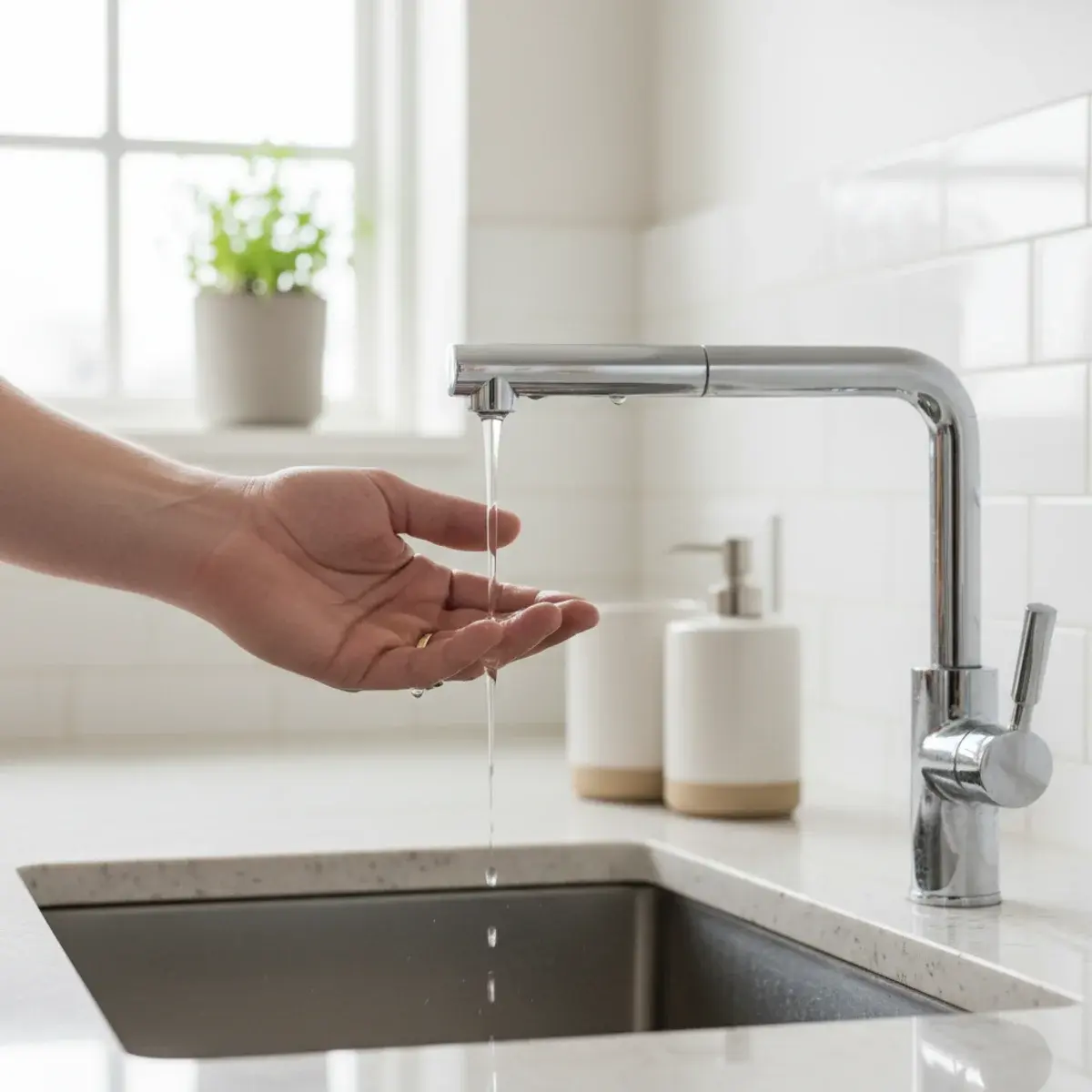
Low water pressure can come from something as simple as a clogged aerator or as serious as a hidden leak or failing pressure regulator. The first clue is whether it affects one fixture or the whole house. Here is how to track it down.
Low water pressure is frustrating, but it is also diagnosable. The single most useful question to ask first is whether the weak pressure affects just one fixture or the entire house, because that immediately splits the possible causes into two very different groups. A single weak faucet is almost always a small, local problem you can often fix yourself. Weak pressure everywhere points to something affecting the whole system — a valve, a regulator, a leak, or the supply. Here is how to work through it.
First, narrow it down: one fixture or the whole house?
Walk around and test several fixtures — kitchen, bathrooms, tub, outdoor spigot. As you do, note whether the problem is universal or isolated, and whether it affects hot water, cold water, or both. Hot-only pressure problems point toward the water heater or its lines; cold-only or both-sides problems point elsewhere. This two-minute survey saves a lot of guesswork.
Causes of low pressure at a single fixture
When only one fixture is affected, the cause is local and usually easy to address.
A clogged aerator or showerhead. The little screen at the tip of a faucet (the aerator) and the holes in a showerhead collect mineral scale and debris. In hard-water areas like San Bernardino, this happens faster and is a very common culprit. Unscrew the aerator or showerhead, soak it in vinegar to dissolve scale, rinse, and reinstall — pressure often returns to normal.
A partially closed shutoff valve. Each fixture has shutoff valves (under sinks, behind toilets). If one is not fully open — sometimes after a repair — flow to that fixture is throttled. Make sure they are open all the way.
A clogged or failing cartridge. Inside the faucet, a worn or sediment-clogged cartridge or valve can restrict flow and may need cleaning or replacement.
A kinked or damaged supply line. The flexible supply lines under a fixture can kink or partially fail, choking flow.
Causes of low pressure throughout the house
When the whole house is weak, the cause is upstream of individual fixtures.
A partially closed main shutoff. If your main shutoff valve or the meter valve is not fully open — perhaps after recent work — pressure everywhere suffers. Confirm the main valve is open completely. This is a simple thing to overlook and an easy fix when it is the cause.
A failing pressure regulator. Many homes have a pressure-reducing valve (PRV) near where the water enters, which keeps incoming municipal pressure at a safe level. When a PRV fails, it can drop pressure throughout the house (or, conversely, let pressure climb too high). A failing regulator is a frequent cause of sudden, whole-house pressure changes and usually needs professional replacement.
A hidden leak. Water escaping through a leak means less reaches your fixtures, so unexplained whole-house pressure loss can be a symptom of a leak inside a wall, under the slab, or underground. If you also see a rising water bill, damp spots, or your meter moving with everything off, suspect a leak and have it located. Our guide to spotting hidden leaks covers the warning signs in detail.
Pipe corrosion and scale buildup. In older homes with aging galvanized pipe — common in parts of San Bernardino — decades of internal corrosion and mineral scale narrow the pipes and steadily reduce flow. This produces a gradual decline rather than a sudden drop, and the long-term fix is often repiping the affected lines.
A municipal supply issue. Sometimes the problem is not in your home at all. Work on city water mains, a supply disruption, or simply lower pressure in your area can reduce what reaches you. If neighbors are affected too, or the issue is temporary, the cause may be on the utility's side.
A simple diagnostic path
- Survey the house. One fixture or all of them? Hot, cold, or both?
- For a single fixture: clean the aerator or showerhead, confirm the fixture shutoffs are fully open, and inspect the supply lines.
- For the whole house: confirm the main shutoff and meter valve are fully open.
- Check the pressure regulator. If pressure is uniformly low or recently changed, a failing PRV is a strong suspect.
- Rule out a leak. Do the meter test — all water off, watch the meter for movement — and look for damp spots and bill increases.
- Consider the pipes. In an older home with a gradual decline, corroded galvanized piping may be the root cause.
- Check with neighbors to rule out a supply-side issue.
When to call a plumber
Clean the aerators and check the valves yourself — those fixes are quick and free. Call a plumber when the whole house is affected and the simple checks come up empty, when you suspect a failing pressure regulator, when the meter test indicates a leak, or when an older home's pressure has been declining for years. A plumber can measure your actual pressure, test the regulator, locate a hidden leak, and assess whether corroded piping is the underlying issue.
The bottom line
Low water pressure is almost always solvable once you know where it is coming from. Start by figuring out whether it is one fixture or the whole house — that single observation points you toward the right cause. Local problems like a scaled-up aerator are easy do-it-yourself wins, while whole-house issues such as a failing regulator, a hidden leak, or corroded pipes call for a plumber. And because hard water drives a lot of the scale-related pressure loss here, periodic cleaning of aerators and showerheads is worthwhile preventive maintenance in San Bernardino.
Frequently Asked Questions
A sudden drop usually points to a specific cause: a partially closed shutoff valve, a failed pressure regulator, a new leak somewhere in the system, or a problem on the municipal supply side. If it came on abruptly and affects the whole house, check your main shutoff and pressure regulator first, then suspect a leak.
When only one fixture is weak, the cause is almost always local. Unscrew and clean or replace the aerator on a faucet or the showerhead, which collect mineral scale in hard-water areas. Also check that the fixture's shutoff valves are fully open. These simple steps resolve most single-fixture pressure problems.
Yes. Over time, mineral scale from hard water builds up inside fixtures, aerators, showerheads, and even pipes, narrowing the openings water flows through. This is a common contributor to gradually declining pressure in San Bernardino homes and is one reason aerators and showerheads need periodic cleaning here.
Need a plumber in San Bernardino?
Call now or request service online and we'll connect you with local plumbing help.